 English
 -
 Tiếng Việt
 -
한국어
-
中文 (中国)
 Tiếng Việt
 한국어
한국어 中文 (中国)
Zirconit (Zirconium Silicate) is one of the most widely used chemicals in the ceramics industry, with applications in various manufacturing sectors. Following the development trend, the consumption volume of this chemical has been continuously increasing.
What are ceramic chemicals?
Ceramic and glass chemicals are additives used in the production process. Their main function is to provide products with the desired properties. Some increase plasticity, some decrease it; some act as fluxes, while others form glass, add color, or create opacity.
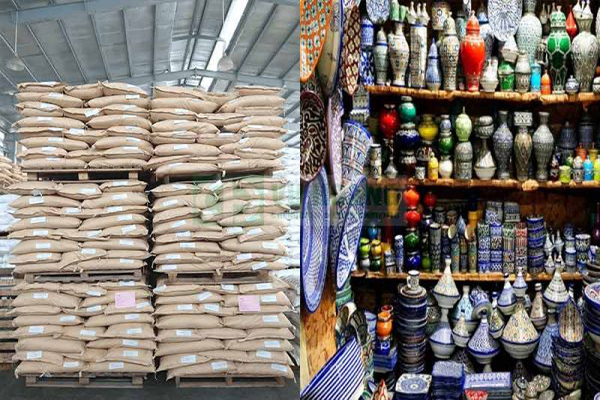
What types of ceramic chemicals are there?
In the ceramic and glass chemical industry, there is a wide variety of types and products. However, the most common and widely used ones include:
Zirconium Silicate (ZrSiO4): A mineral belonging to the nesosilicate group. Its corresponding chemical formula is zirconium orthosilicate (ZrO2 + HfO2). Zircon is used as an opacifier in the ceramics industry. To achieve the opaque white color in glazes, the process involves reflection and refraction under heat through reactions at various stages of zircon within the glaze structure.
Feldspar: Plays a major role in firing, promotes reactions, has little to no plasticity (very low if any), is hard to grind, supplies alkali to the mixture, and lowers firing temperature.
Limestone, precipitated calcium carbonate, calcite:
These are the main raw materials for glaze frit production. Nowadays, they are rarely used in tile bodies but mainly in matte glazes or glaze frit preparation.
In nature, limestone and calcite exist as stone, while precipitated calcium carbonate is processed from limestone or calcite.
Their main chemical composition is CaCO3 with a small amount of MgCO3, plus minor impurities.
Main functions in glazes:
At low levels, they help form a liquid phase in the glaze and increase gloss.
At higher levels, they produce opacity or a matte effect depending on the amount used. Currently, they are mainly applied in glaze frit manufacturing.
Zircon: Characterized by very high whiteness, even after high-temperature firing. Therefore, zircon is mainly used in glazes to enhance whiteness. Another important application is in engobe (undercoat glaze), giving it opacity to block visibility and providing the following functions:
Acts as a background color when transparent glaze is used, since transparent glaze is glassy and see-through, making the undercoat color visible as the product’s color.
Hides the red or dark brown color of tile bodies, allowing transparent glazes and decorative colors to achieve the same visual quality as when using white bodies.
Liquid glass (sodium silicate): An electrolyte that increases the fluidity of glaze slurry when used in proper proportions.
CMC (Carboxyl Methyl Cellulose) binder additive: Improves bonding and increases viscosity of glaze slurry.
Aluminum Oxide (Al2O3): Its effect in glaze depends on the amount added. At low levels, with good interaction with other oxides, it acts as a flux, creating transparent and glossy glazes.
Increasing Al2O3 raises melting temperature and viscosity, reduces glaze flow, broadens melting temperature range, lowers thermal expansion coefficient, and improves thermal, mechanical, and chemical durability. High Al2O3 content increases opacity and reduces crystallization tendency. Al2O3 is introduced into glazes via kaolin, clay, feldspar, and in some cases as Al2O3 oxide or Al2O3 hydroxide.